

Hey there!
You signed up for our Spiralist Productivity Shots newsletter a while back.
Here’s our short story: we’re a small team of three friends. While building Spiralist, we pushed too hard and totally burned ourselves out. To the point, where we had to stop building Spiralist and take a break.
We realized a need for a better way to stay productive without burning out.
So we turned to mindfulness — through the lens of neuroscience (felt natural to our engineering brains). That’s how we stumbled onto the concept of mindful productivity: working in a way that balances results with well-being.
After practicing mindful productivity for over six months, we’ve found it genuinely helpful. We want to share what we’ve learned—and what we’re still learning. That’s why we’re evolving our productivity newsletter into The Weekly Protocol. A weekly dose of science-backed mindful productivity tips, grounded in research and tested in real life by us.
Every Tuesday, you’ll get one 5-minute, science-backed productivity protocol. You’ll learn:
When to use it
Why it works
Exact steps to try today
One email, one small win. No fluff, no link dumps.
Below you’ll find a sample of our first issue — we’d love for you to read it.
And yes, Spiralist is back in active development too.
👉 If you don't want to receive these mails in future, you can unsubscribe anytime at the footer — No hard feelings.
Why It’s Hard to Focus — and How to Do It Without Willpower
It’s 2 PM on a Tuesday. You sit down to tackle a critical report, determined to finally make progress. You open the document, read the first sentence, and then... your mind is somewhere else.
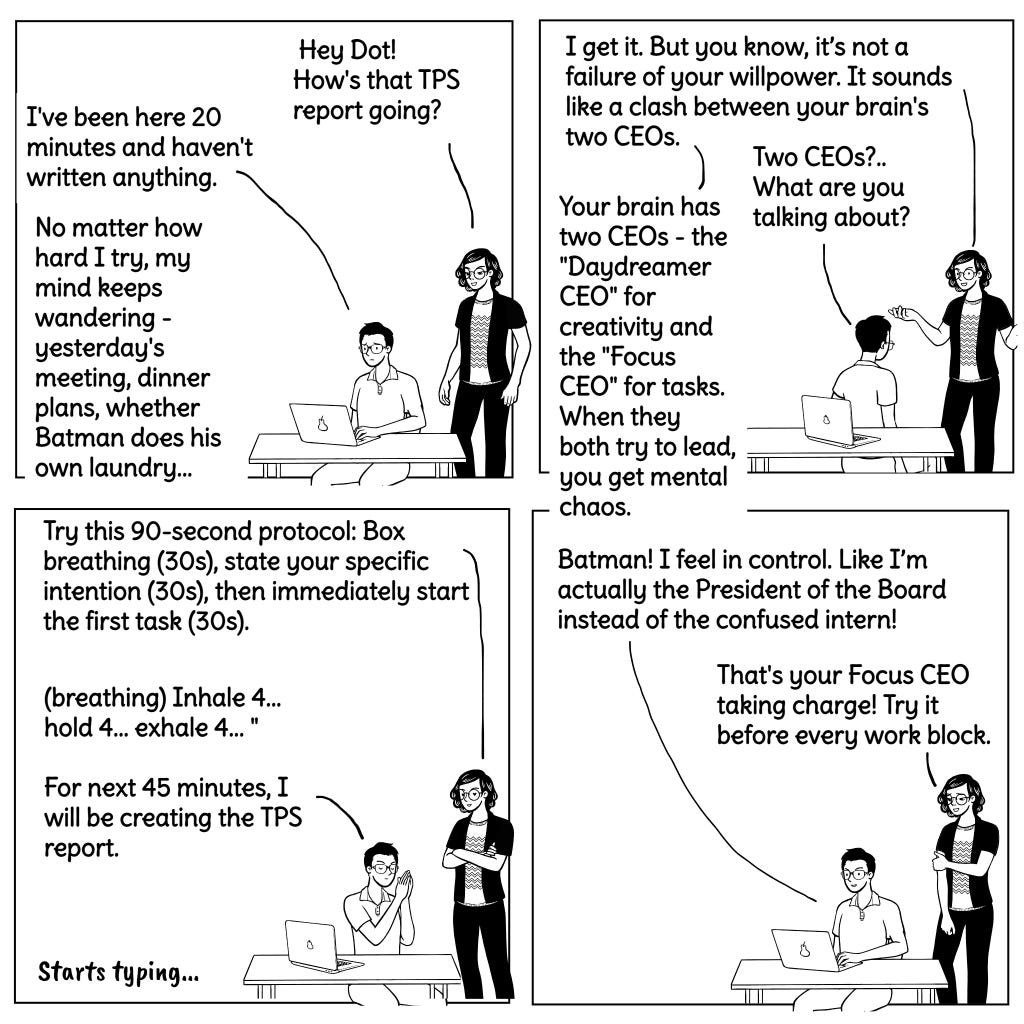
You’re thinking about a conversation from yesterday, what to make for dinner, or that nagging feeling you’ve forgotten something important. Twenty minutes fly by, and you’ve written nothing.
If you’ve ever stared at a screen, wanting to focus but feeling hijacked by your own thoughts — we’ve been there too.
This isn’t a failure of willpower. It’s a tug-of-war between large-scale brain systems that shape attention. There’s a way to nudge them into the mode you need.
The Science
Neuroscientists have identified two remarkable, and competing, networks in our brain. Understanding them is the first step to winning the battle for focus.
1. The Daydreamer CEO (The Default Mode Network - DMN): This is your brain's creative, free-wheeling, imaginative leader. When you're not focused on a specific external task, the DMN takes over. It's responsible for daydreaming, remembering the past, thinking about the future, and those brilliant "aha!" moments in the shower. It's the source of your creativity and self-reflection.
2. The Focus CEO (The Task-Positive Network - TPN): This is your "get it done" leader. The TPN is the brain's mission control, activating when you engage in tasks that demand attention, planning, and problem-solving. When you’re writing an email, analyzing a spreadsheet, or deep in conversation, your TPN is in charge.
Here’s the catch: in a healthy brain, these systems often work in opposition. There is a control network that helps you switch between them depending on the task. In simpler terms, these two networks operate like a seesaw. When one is active, the other is quiet. When you need to focus, the TPN takes over, and the Daydreamer CEO steps back.
The Impact
For most of us, when dealing with stress and burnout, that seesaw is broken.
The Daydreamer CEO (DMN) doesn't quiet down. It stays active even when you're trying to focus, constantly interrupting with anxieties, ruminations, and random thoughts.
This isn't just distracting, it’s mentally exhausting.
A hyperactive DMN is strongly linked to feelings of anxiety and rumination, where our minds get stuck in loops of negative self-referential thoughts.
That feeling of being busy but not productive? That's the feeling of your two CEOs trying to talk at the same time.
You’re fighting a constant internal battle for your own attention, which is exhausting and a direct path to burnout. You're not lazy or undisciplined; your brain's operating system is getting hijacked.
President of the Board
What if you could stop the internal battle? What if you could choose which CEO is in charge at any given moment?
The goal isn’t to silence the Daydreamer CEO forever—its creativity is invaluable.
The goal is to train it to step back when the Focus CEO needs to take the stage.
Mindful productivity is about flexibly moving between internal and external modes deliberately—directing your “board meeting” instead of being a spectator.
By learning to consciously and deliberately transition between these states, you move from being a passenger in your own mind to being the driver. You become the President of the Board, directing your inner leaders instead of being pulled apart by them.
How to Try It: The 90-second protocol
Next time, rather than trying to ‘focus harder,’ use this quick neurological reset.
Before you start your next block of focused work, run this simple protocol to help your brain shift from internal chatter (DMN) to task-focused attention networks(TPN).
Step 1: The Pause (30 seconds)
Do box breathing: inhale 4, hold 4, exhale 4—repeat for 2–3 cycles. Keep it nasal and gentle. Slow, paced breathing improves autonomic flexibility and mood.
Step 2: The Intention (30 seconds)
Silently state one specific task for this block (if-then style):
“If it’s 2:05, then for the next 45 minutes, my sole focus will be drafting the introduction to the Q3 report.”
These “implementation intentions” reliably increase follow-through
Step 3: The Launch (30 seconds)
Open the one document/tool and type the first sentence or outline bullets before checking anything else. Starting immediately helps snap attention to the task at hand.
This isn’t a “hack”, it's a training habit that compounds over time. By performing this small, goal-directed action, you help your brain make the crucial switch from internal chatter to external focus, giving your TPN the signal that it's time to take the lead.
The Payoff
By consistently using this 90-second reset, you’re not just fighting distractions — you’re retraining your brain’s operating system.
Picture this: tomorrow morning you open your laptop, and instead of battling distraction, you slip straight into deep focus within minutes. That’s what this protocol trains your brain to do.
This is the power of becoming the “President of the Board”: you decide when creativity steps up and when focus takes the stage.
The battle for your attention is winnable. It starts not with more effort, but with more awareness.
Try the protocol before your first 45-minute block tomorrow. See how it feels to start the day in control of your attention.
And if you try it, hit reply — I’d love to hear how it went.
Until next week,
Kayron Chip
Mindful Productivity Lab
References
Fox MD et al. PNAS (2005): intrinsic anticorrelated networks (task-positive vs default). PNAS
Sridharan D et al. PNAS (2008): right fronto-insular cortex as a switcher (salience network). PNAS
Hamilton JP et al. Biol Psychiatry (2011, 2015): DMN dynamics & rumination in depression. PMC PubMed
Zaccaro A et al. Front Hum Neurosci (2018) & Russo MA et al. (2017): slow breathing and autonomic/CNS effects. Frontiers PMC
